

Hot Mix Asphalt (HMA) has been the undisputed standard of the paving industry for decades. However, as the construction sector evolves toward greater sustainability, operational efficiency, and enhanced occupational health and safety, warm mix asphalt (WMA) has rapidly transformed from a niche alternative into a mainstream necessity.
While the industry frequently praises WMA for asphalt applications due to its environmental benefits (specifically lower fuel consumption and reduced carbon footprints), an equally compelling advantage is the dramatic improvement of jobsite working conditions for paving crews.
Beyond Sustainability: The Operational Push for WMA
The initial push for warm mix technology was driven by regulatory pressures, environmental compliance, and rising fuel costs. Reducing production temperatures translates directly to burning less fuel at the asphalt plant, which can yield measurable reductions in greenhouse gas emissions such as carbon dioxide (CO2), sulfur dioxide (SO2), and volatile organic compounds (VOCs).
Paving contractors quickly discovered that adopting WMA for asphalt extended operational advantages far beyond plant chimneys. In an era where crew retention, labor shortages, and stringent workplace safety regulations (such as OSHA guidelines) dictate project success, contractors are re-evaluating modern asphalt additives through the lens of human labor. Utilizing WMA for bitumen modification provides a tangible solution to everyday jobsite challenges, turning harsh, high-risk work environments into safer, significantly more manageable work zones.
How WMA Differs Distinctively from Hot Mix Asphalt
To understand why warm mix asphalt (WMA) transforms the jobsite, one must examine the core technical differences between conventional Hot Mix Asphalt (HMA) and WMA mixes.
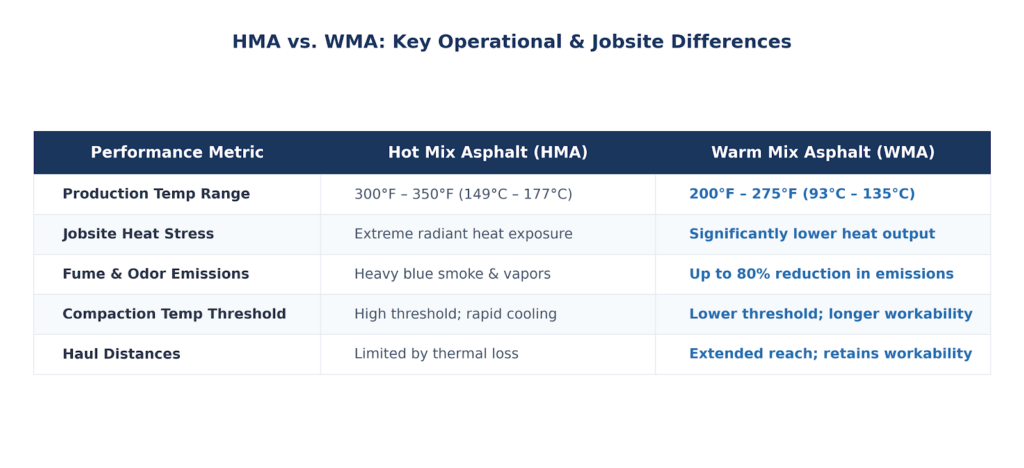
Traditional HMA is typically produced and mixed at temperatures ranging between 300°F to 350°F (149°C to 177°C) and compacted at similar elevated ranges. In contrast, WMA technologies lower the required asphalt compaction temperature significantly, allowing the mix to achieve necessary workability and compaction at temperatures between 200°F to 275°F (93°C to 135°C). This represents a thermal reduction of 30°F to 70°F (15°C to 38°C).
The ability to compact asphalt at these lower temperatures is not only a matter of reducing binder viscosity. As temperature decreases, bitumen generally becomes more viscous, increasing resistance to movement within the asphalt mixture. At the same time, friction between the binder and aggregate particles and within the aggregate structure affects how readily the mix can be worked and compacted.
The Stribeck curve provides a useful representation of this relationship, illustrating how lubrication and frictional resistance change as conditions within the mixture change. WMA technologies like PHALANX® are designed to reduce this resistance and improve the lubricating behavior of the binder during production and compaction, which is especially important as the mix cools while compaction is underway.
WMA technologies can improve the workability and reduce internal friction within the mix at lower temperatures. This allows aggregate particles to move and rearrange more readily during compaction. Once the mixture cools, the binder can recover its intended physical characteristics. As a result, WMA can achieve the required density and performance while being produced and compacted at substantially lower temperatures than conventional HMA.
Direct Jobsite Improvements for Paving Crews
The 30°F to 70°F temperature drop radically improves day-to-day conditions on the mat. The primary jobsite benefits include the following considerations.
Substantial Reduction in Fumes, Smoke, and Odor
One of the immediate sensory shifts upon introducing warm mix asphalt (WMA) to a jobsite is the drastic decrease in visible "blue smoke" and asphalt odor. Asphalt fumes contain organic compounds that evaporate rapidly when exposed to temperatures exceeding 300°F. By lowering production temperatures below these thresholds using a high-performance warm mix additive, volatile emissions can drop.
Research shows that visible fume generation is reduced by up to 80% when using WMA for asphalt projects. Rakers, screed operators, and roller drivers no longer work in dense clouds of asphalt vapors, resulting in cleaner air, fewer eye irritations, reduced respiratory distress, and a much cleaner overall work environment.
Lower Thermal Stress and Heat Fatigue
Asphalt workers face extreme physical demands, often working in peak summer heat on surfaces that radiate intense heat directly upward. Ambient heat combined with 320°F hot mix creates severe microclimates, accelerating dehydration, heat exhaustion, and fatigue.
Implementing WMA for bitumen applications lowers surface temperature radiation significantly, reducing the localized ambient heat index for workers standing on or adjacent to the uncompacted mat. This reduction in thermal load can lower the incidence of heat-related illnesses and keep workers safer throughout long shifts.
Extended Compaction Window and Improved Workability
Because HMA cools rapidly, crews operate under intense time pressure to compact the mix before it drops below its required asphalt compaction temperature. This creates high stress on the jobsite and can lead to uneven density or poor joint construction.
WMA remains pliable and more compactable at lower temperatures than HMA, offering an extended compaction window. Crews have more time to carefully finish joints, navigate around utility structures, and achieve targeted density without frantic rush.
Superior Night-Time and Cool-Weather Paving
Paving at night or during shoulder seasons (late fall and early spring) poses severe cooling risks for HMA, as cold ambient air rapidly strips heat from the mix. Using a specialized warm mix additive for asphalt maintains internal workability at lower operating thresholds, allowing crews to comfortably pave during cooler weather or overnight closures without sacrificing quality or resorting to extreme heating practices.
PHALANX: Advanced Warm Mix Additive
Achieving effective warm mix performance requires more than simply reducing the temperature of an asphalt mixture. The WMA technology must improve workability and compactability at lower temperatures while allowing the finished pavement to retain the performance characteristics required for long-term service. This makes the selection of the warm mix additive an important part of mix design.
PHALANX is engineered to address these requirements through its surface-active and lubrication-enhancing properties. Rather than relying on viscosity reduction alone, PHALANX improves wettability between the binder and aggregate and reduces friction within the mixture. This helps the aggregate particles move and pack more efficiently during compaction. This also enables producers and contractors to achieve effective compaction at reduced temperatures while maintaining the characteristics of the underlying binder.
PHALANX Technology Overview
PHALANX is a high-performance warm mix additive for asphalt designed to lower asphalt production and target asphalt compaction temperature thresholds by 30°F to 60°F without compromising binder properties or asphalt film thickness.
PHALANX reduces binder viscosity and surface tension, acting among top-tier bitumen additives to allow complete aggregate coating at lower temperatures. It is also highly effective at minimal dosages, making it an economical choice for plants and contractors deploying WMA for bitumen modifications.
Unlike mechanical foaming systems that require expensive capital modifications to asphalt plants, PHALANX can be dosed directly into the liquid asphalt supply. Its specialized formulation works at the microscopic interface between the asphalt binder and aggregate, reducing internal shear resistance.
For rakers and shovel workers handling hand-work around catch basins and radius cuts, mix treated with this warm mix additive for asphalt remains soft, pliable, and easy to maneuver without aggressive pulling or tearing. PHALANX also enables rollers to achieve required target voids at a lower asphalt compaction temperature with the opportunity to streamline asphalt production.
Paving a Safer, More Efficient Future
Warm mix asphalt represents a fundamental shift in infrastructure construction. While lower emissions and fuel savings will always make headlines, the true daily beneficiaries of deploying WMA for asphalt are the teams at the jobsites. By reducing hazardous fumes, moderating thermal exposure, lowering the target asphalt compaction temperature, and providing a more workable material, advanced asphalt additives can create a healthier, less exhausting, and vastly more productive workplace.
For more information about warm mix additives and PHALANX, visit www.sripath.com or contact info@sripath.com.
