

As road networks are exposed to increasingly severe weather patterns, the demands placed on asphalt pavements continue to grow. Longer heat waves, heavier rainfall events, wider seasonal temperature swings, and increased traffic loads are all contributing to accelerated pavement deterioration. For agencies and contractors, the challenge is to formulate asphalt mixtures capable of maintaining performance throughout decades of environmental exposure.
Achieving greater asphalt durability in extreme weather conditions requires an understanding how pavements fail at the material level. Most forms of pavement distress originate within the asphalt binder as it ages, oxidizes, stiffens, or deforms under repeated loading. Innovations in bitumen and asphalt additives are allowing engineers to address these failures before they develop into costly maintenance issues.
Understanding Asphalt Aging and Environmental Stress
Although asphalt pavements appear rigid, they are actually viscoelastic materials that must continuously balance flexibility with stiffness. This balance becomes difficult as environmental conditions change throughout the pavement's service life.
Immediately after production, asphalt binders begin to undergo oxidation. As oxidation progresses, the binder gradually becomes stiffer and more brittle. Thermal oxidation, ultraviolet radiation, moisture infiltration, freeze-thaw cycles, and repeated traffic loading accelerate this aging process. Over time, these changes reduce the pavement's ability to accommodate movement without cracking while also increasing susceptibility to moisture damage.
These deterioration mechanisms rarely occur independently. Instead, they form a continuous cycle in which environmental stress accelerates binder aging, leading to multiple forms of pavement distress.
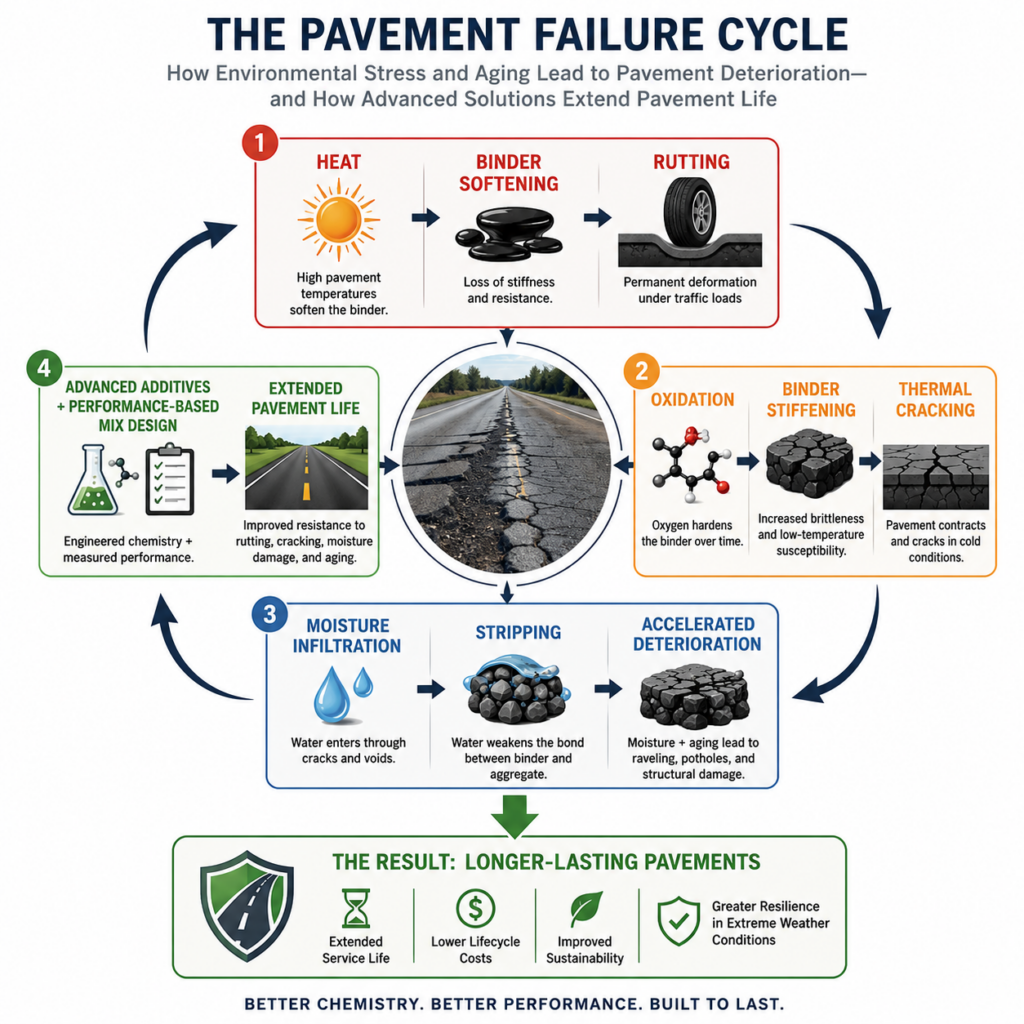
Figure 1: Environmental stress initiates a repeating cycle of binder aging, pavement deterioration, and structural damage. Modern additive technologies interrupt this cycle by improving binder resilience and long-term performance.
Pavement design should focus on achieving initial performance while also slowing the mechanisms responsible for asphalt aging throughout the pavement lifecycle.
How High Temperatures Accelerate Rutting
High pavement temperatures present a large challenge to long-term performance. As temperatures rise, conventional binders soften and lose resistance to permanent deformation. Under repeated wheel loads, the asphalt mixture slowly shifts laterally, creating depressions known as rutting. Severe rutting compromises ride quality, reduces drainage, and increases safety risks.
Traditional methods of improving rut resistance often relied on harder binders or increased polymer contents. While effective in certain applications, these approaches can increase viscosity, complicate production, and make pumping, mixing, and compaction more difficult.
Advances in polymer modified asphalt technology focus on improving high-temperature performance while maintaining practical handling characteristics during production.
Why Low Temperatures Cause Thermal Cracking
The opposite challenge occurs during cold weather. As pavement temperatures decrease, asphalt binders naturally contract. If the binder has become excessively stiff through aging, it can no longer accommodate these movements. Tensile stresses develop until the material fractures, creating thermal cracks that allow moisture and oxygen to penetrate deeper into the pavement structure. Once initiated, these cracks accelerate additional deterioration through freeze-thaw damage and moisture intrusion.
Mix designers face the problem of maintaining low-temperature flexibility while preserving high-temperature rut resistance. Increasingly, performance-based testing rather than relying solely on traditional binder grading methods, is being used to evaluate mix performance.
The Impact of Water and Oxidation on Pavement Life
Moisture often acts as the catalyst that accelerates pavement deterioration. Water infiltrates through surface cracks, joints, and interconnected air voids. This can weaken the bond between binder and aggregate. This stripping process reduces structural integrity and leaves mixtures more vulnerable to raveling, fatigue cracking, and permanent deformation.
Oxidation compounds this problem by increasing binder stiffness over time. The combination of moisture damage and oxidative aging often produces a cycle of progressive deterioration that shortens pavement service life well before structural capacity is exhausted.
Innovations in Bitumen Chemistry
Significant advances in asphalt performance are now being driven by improvements in binder chemistry rather than simply increasing binder grade or polymer dosage.
Asphalt additives are engineered to modify specific characteristics of the asphalt binder including compactability, viscosity, aging resistance, and workability. These materials can alter the behavior of the binder to create more stable, durable asphalt mixtures.
These innovations in bitumen and asphalt additives enable engineers to design mixtures that maintain desirable performance characteristics across a much wider range of environmental conditions while simplifying production and placement.
The industry's growing adoption of Balanced Mix Design (BMD) further supports this evolution. This is because it emphasizes measured pavement performance such as rutting resistance, fatigue performance, and cracking resistance instead of relying exclusively on volumetric properties.
New Additive Technologies Improving Pavement Resilience
Polymer compatible binder modifiers have emerged as an effective approach for improving pavement durability without many of the processing challenges associated with traditional modification methods.
PGXpand® is a bitumen-friendly polymeric additive designed to improve binder performance by modifying bitumen chemistry while maintaining low viscosity and excellent storage stability. Unlike conventional elastomeric and plastomeric modification systems that often require high shear mixing and elevated polymer contents, PGXpand integrates readily into existing production processes.
The result is a binder that delivers improved resistance to permanent deformation at elevated temperatures while maintaining desirable handling characteristics during manufacturing and paving operations.
Because PGXpand supports lower production viscosities, producers can achieve targeted performance grades with improved workability, simplified pumping, and more efficient plant operations. The additive also enables the development of hybrid polymer systems that combine multiple modifier technologies while maintaining storage stability.
Long-term pavement durability also depends on maintaining flexibility as temperatures decline and the binder continues to age. NuMIXER®, a bio-based bitumen softener, is engineered to improve low-temperature flexibility and cracking resistance by enhancing the binder's ability to accommodate thermal stresses without becoming excessively brittle.
This improved flexibility helps pavements withstand seasonal temperature fluctuations and extreme cold weather events while reducing the risk of thermal cracking. NuMIXER-treated binders also exhibit excellent aging characteristics, helping preserve desirable rheological properties over time and slowing the progressive stiffening associated with oxidation. The result is a more durable binder capable of maintaining performance throughout a longer service life.
Together, technologies such as PGXpand and NuMIXER demonstrate how binder chemistry can be tailored to address different pavement failure mechanisms. By improving high-temperature deformation resistance, low-temperature flexibility, and long-term aging performance, these asphalt additives help engineers design mixes capable of delivering more reliable performance across a broader range of climates and service conditions.
What the Next Generation of Asphalt Performance Looks Like
The future of asphalt durability in extreme weather conditions will depend on designing pavements that resist multiple forms of deterioration simultaneously. Performance-based specifications, Balanced Mix Design methodologies, and advanced binder technologies are shifting the industry toward a more holistic understanding of pavement behavior.
As climate variability continues to place greater demands on transportation infrastructure, additive technologies will play an increasingly important role in extending pavement life while improving sustainability and lifecycle cost efficiency. Solutions such as PGXpand and NuMIXER demonstrate how advances in binder chemistry can improve pavement resilience by enhancing the performance of polymer modified asphalt without sacrificing workability or manufacturing efficiency.
For more information about PGXpand and NuMIXER, visit www.sripath.com or contact info@sripath.com.
