
Polymer modified asphalt (PMA), or polymer modified bitumen, has long been used to improve pavement durability under increasing traffic loads, climate variability, and performance-based specifications. Traditionally, PMA has relied on elastomeric or plastomeric polymers to enhance specific properties such as rutting resistance and durability. While effective, these approaches often introduce challenges related to storage stability, viscosity control, energy consumption, and cost.
As the asphalt industry continues to prioritize sustainability alongside long-term performance, a shift is underway toward engineered, high-performance PMBs. PGXpand® offers a different approach to polymer modification that improves performance, reduces environmental impact, and maintains compatibility with the asphalt binder and production processes.
The Shift Toward Engineered, Bitumen-Friendly Asphalt Polymers
Conventional polymer modified asphalt systems typically rely on forming a distinct polymer phase within the binder. Elastomeric polymers such as SBS are widely used for improving elasticity and high-temperature performance, while plastomeric modifiers can increase stiffness and deformation resistance. However, these systems may require higher production temperatures, elevated polymer contents, and additional handling considerations to maintain stability and workability.
Engineered asphalt polymers are designed to integrate more effectively with the bitumen phase, supporting consistent performance without excessive stiffening or processing complexity. Rather than relying solely on polymer type or dosage, this approach emphasizes compatibility, homogeneity, and balanced performance across temperature ranges.
PGXpand fits within this emerging category by functioning as a bitumen-friendly polymeric additive. Its role is to enhance binder performance while preserving practical considerations such as viscosity control, storage stability, and constructability, all of which are key factors for modern asphalt production environments.
PGXpand as an Asphalt Performance Modifier
Unlike traditional elastomeric or plastomeric modifiers, PGXpand is engineered to work with the asphalt binder rather than form a separate polymer network. This distinction allows it to deliver meaningful performance improvements without introducing the processing challenges often associated with conventional PMA systems.
As an asphalt performance modifier, PGXpand supports:
- Improved high-temperature resistance without excessive viscosity increase
- Enhanced balance between stiffness and flexibility
- Stable binder properties during storage and handling
PGXpand-modified binders maintain homogeneity and are immune to phase separation compared to traditional PMBs. This contributes to predictable performance, reduced energy demand during production, and improved ease of use in both terminal blending and paving operations.
Performance and Practical Benefits of PGXpand PMB
PGXpand-dosed polymer modified asphalt provides benefits beyond traditional distress mitigation, addressing both performance and constructability needs.
Performance and Durability
- Improved rutting resistance at elevated temperatures, supporting heavy traffic and warm climate applications
- Acceptable fatigue resistance at intermediate temperatures, helping reduce crack initiation and propagation
- Balanced temperature performance, anchoring low-temperature properties while improving high-temperature grade
Production and Constructability
- Excellent storage stability compared to many conventional PMB systems
- Lower binder viscosity at typical production temperatures
- Easier compaction of asphalt mixtures in the field
- Reduced energy consumption during PMB manufacturing and placement
Cost and Sustainability
- Lower cost to manufacture and use PMB relative to traditional polymer systems
- Reduced CO₂ and greenhouse gas emissions through lower processing temperatures
- Less frequent pavement repair due to good long-term performance
Together, these benefits position PGXpand as a practical solution for agencies and producers seeking performance improvements without added complexity.
Case Studies: PGXpand and Impact on Binder Properties
Data generated using a PG 64-22 base binder demonstrates the measurable impact of PGXpand on key binder properties. As PGXpand dosage increased from 1.5% to 3.0%, the true performance grade showed a substantial improvement in high-temperature capability while maintaining stable low-temperature performance. For example, the base binder’s true grade of approximately 66.8 °C improved to as high as 95.0 °C with PGXpand, while low-temperature values remained anchored near −25 °C.
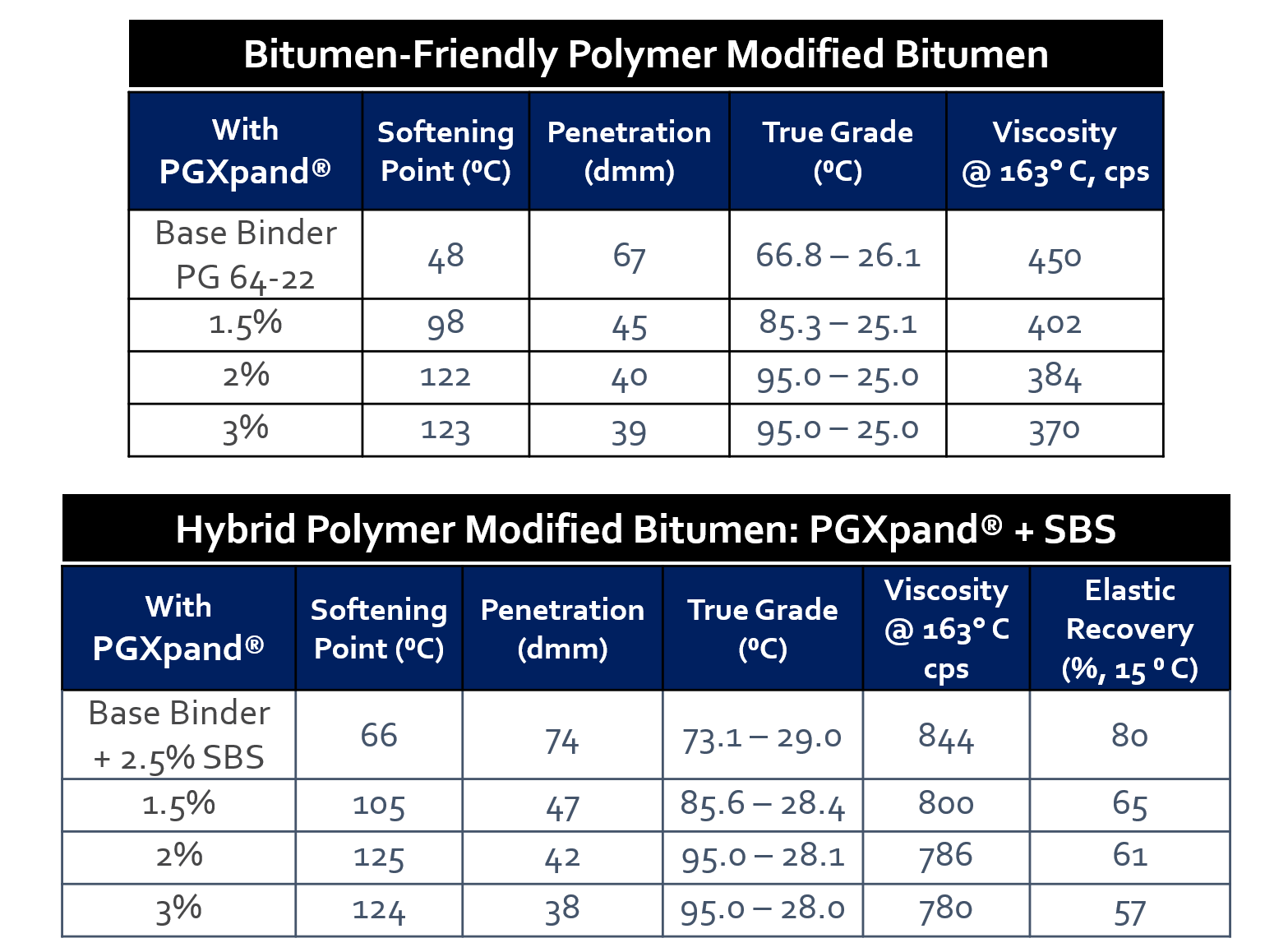
Notably, these gains were achieved alongside a reduction in viscosity at 163 °C, decreasing from 450 cps in the base binder to approximately 370 cps at higher PGXpand contents. This combination of higher high-temperature grade and lower viscosity highlights the bitumen-friendly nature of the additive and its contribution to improved workability.
In hybrid polymer modified bitumen systems combining PGXpand with SBS, additional performance enhancements were observed. PGXpand increased softening point and true grade while reducing viscosity relative to SBS-only binders. Elastic recovery values remained within performance expectations, indicating PGXpand can complement elastomeric systems while improving processing efficiency and overall balance of properties.
These results demonstrate how PGXpand supports improved high-temperature performance, stable low-temperature behavior, and practical viscosity control across a range of PMB formulations.
Why Engineered Polymers Are Shaping the Future of PMA
The need for adaptable, predictable asphalt performance modifiers continues to grow across the bitumen industry. Engineered, bitumen-compatible polymers provide a pathway to meet these demands without sacrificing constructability or cost efficiency.
PGXpand exemplifies this next generation of polymer modified asphalt technology by addressing performance, production, and environmental considerations simultaneously.
For more information about polymer modified asphalt, PMB mixes, and PGXpand, contact info@sripath.com.
