
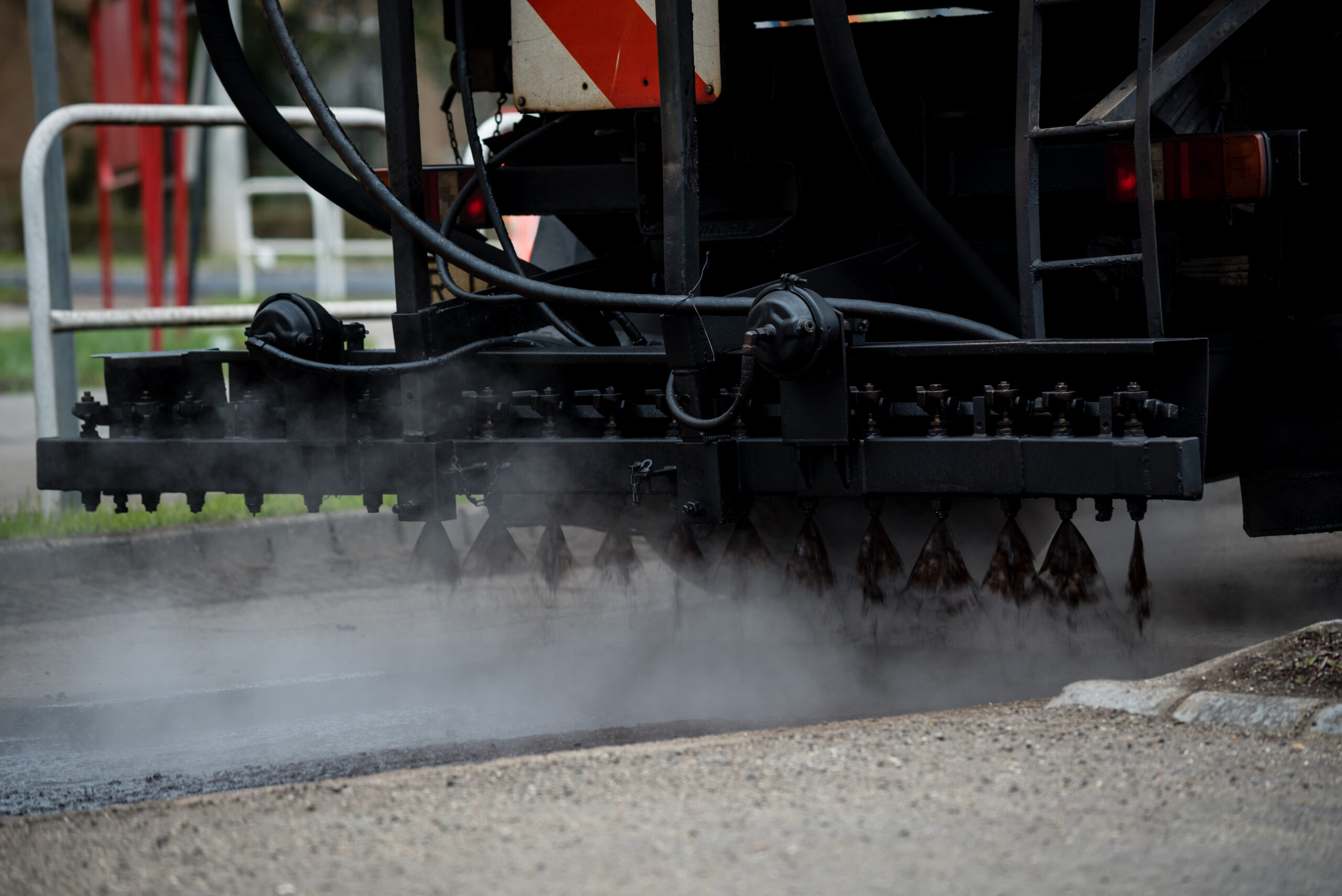
Asphalt emulsions play a crucial role in improving pavement performance, extending lifecycle, and supporting sustainability initiatives. Unlike traditional hot mix asphalt alone, bitumen emulsion allows for more controlled application, better workability, and compatibility while maintaining high durability and efficiency in both new and rehabilitated pavements. Understanding the science behind emulsion performance can help engineers maximize its benefits.
What Factors Affect the Performance of Asphalt Emulsions?
The performance of an asphalt emulsion depends on several interrelated variables, beginning with its composition and chemistry. Key factors include:
- Particle charge and droplet size: Cationic, anionic, or nonionic emulsions behave differently depending on the surface properties of aggregates. Smaller droplet sizes generally promote faster coating and more uniform binder distribution.
- Emulsion grade and viscosity: The intended application, such as tack coat, chip seal, or cold mix, dictates the proper grade. Low-viscosity emulsions improve workability in surface applications while high-viscosity emulsions can enhance residual binder content.
- Aggregate compatibility: Proper adhesion between the emulsion and aggregates is essential to prevent stripping or early raveling. Compatibility is influenced by mineralogy, moisture content, and surface treatment.
By understanding these variables, pavement engineers can select emulsions that optimize binder retention, adhesion, and eventual cured properties.
How Does Temperature Impact Asphalt Emulsion Application?
Temperature plays a critical role during both the application and curing of the bitumen emulsions. Several factors must be considered:
- Evaporation rate: Water must be eliminated from the surface of the aggregate or substrate. This can occur by evaporation from the emulsion binder or by chemical collapse of the emulsion by interaction with the aggregate/substrate. In some cases, both can cause emulsion collapse. This process is dependent upon aggregate/substrate composition, chemical composition of the emulsion, and weather conditions.
- Dew point and ambient moisture: High moisture content or low temperature can slow curing, leading to longer traffic opening times or reduced initial strength.
- Residual binder development: As the water evaporates and the emulsion breaks, the residual asphalt forms the final binder layer. Controlled curing ensures uniform film thickness and durability.
Proper temperature management ensures the emulsion develops sufficient cohesion and adhesion, resulting in a longer-lasting pavement surface.
Do Additives Improve the Performance of Asphalt Emulsions?
Additives and modifiers can significantly enhance the performance of asphalt emulsions, addressing both durability and workability. For example, polymers can reduce susceptibility to rutting and improve resistance to thermal cracking. Dosing a mix with nanomaterials can also help improve aggregate bonding and resistance to moisture damage, particularly in regions with heavy rainfall or freeze-thaw cycles.
By carefully selecting additive-modified emulsions, contractors can achieve superior performance outcomes, especially in demanding climates or high-traffic applications. Brand-specific solutions, like proprietary polymer emulsions, can further optimize productivity and lifecycle performance.
Can Asphalt Emulsions Help Achieve Sustainability Goals?
Bitumen emulsions play an important role in supporting sustainability initiatives within the road construction industry. Unlike traditional hot-mix asphalt, some emulsions can be applied at much lower temperatures, which can significantly reduce the energy required during both production and application. This decrease in energy demand translates directly to lower greenhouse gas emissions and less fuel consumption on site. Additionally, because asphalt emulsions typically do not need to be heated to extreme temperatures, they can help minimize emissions and airborne particulates to help create a safer and healthier environment for workers.
Beyond energy savings, the use of asphalt emulsions also encourages responsible resource management. Their versatility allows them to be used in rehabilitation and maintenance projects, extending pavement lifespan and reducing the frequency of full reconstruction cycles. In this way, asphalt emulsions contribute to circularity in road construction, aligning with broader sustainability and environmental stewardship goals.
Field Variables That Most Influence Asphalt Emulsion Success
The performance of an asphalt emulsion in the field depends on more than just its chemistry. Even the best-formulated bitumen emulsion can underperform if application conditions are not managed. Several key field variables consistently influence emulsion success, and paying attention to them can make the difference between a long-lasting pavement and one prone to early distress.
Ambient and Pavement Temperature During Application
Temperature affects both the emulsion's viscosity and its breaking/curing rate. Too low and the emulsion may not adhere to the aggregate and/or cure properly. Too high and rapid water evaporation can cause uneven binder distribution.
Surface Moisture and Aggregate Preparation
Excess moisture on the pavement or poorly cleaned aggregates can prevent proper adhesion and lead to stripping or raveling. Ensuring the surface is dry and well-prepared is critical.
Emulsion Grade and Residual Binder Content
Matching the emulsion grade to the intended application ensures the correct balance between workability and performance. Sufficient residual binder is essential for durability.
Application Rate and Uniformity
Uneven spreading or incorrect rates can result in weak spots or over-saturated areas, compromising pavement integrity. Controlled and uniform application rate is key to consistent performance.
Specifying High-Performance Asphalt Emulsions
Optimizing asphalt emulsion performance in modern pavements requires a thoughtful balance of material selection, application practices, and field awareness. Engineers should choose the correct emulsion grade to match traffic conditions and application type. Environmental factors such as ambient temperature, pavement moisture, and surface preparation must be monitored closely to ensure proper adhesion and curing. Careful control of application rate and uniformity, along with the strategic use of additives, can significantly improve binder performance and long-term pavement life.
By integrating these considerations and aligning emulsion selection with sustainability and circular economy goals, paving professionals can achieve superior performance and extended surface lifecycles.
For more information about bitumen emulsions and asphalt additives, contact info@sripath.com.
