
We're pleased to feature this insight from Steve Halligan at Road Surfacing SOLUTIONS, who brings experience in sustainable road construction and asphalt technologies to explore the topic of hot spray seal for Australian roadways.
This article explores hot spray seal (thin road surfacing), the materials used to create sprayed seals and uses scenarios to demonstrate different types of seals, and the relationship to the road traffic and environment. The terms sprayed seal, bitumen seal, polymer modified binder seal, seal or seals may be used through the article and can be taken to be essentially the same application.
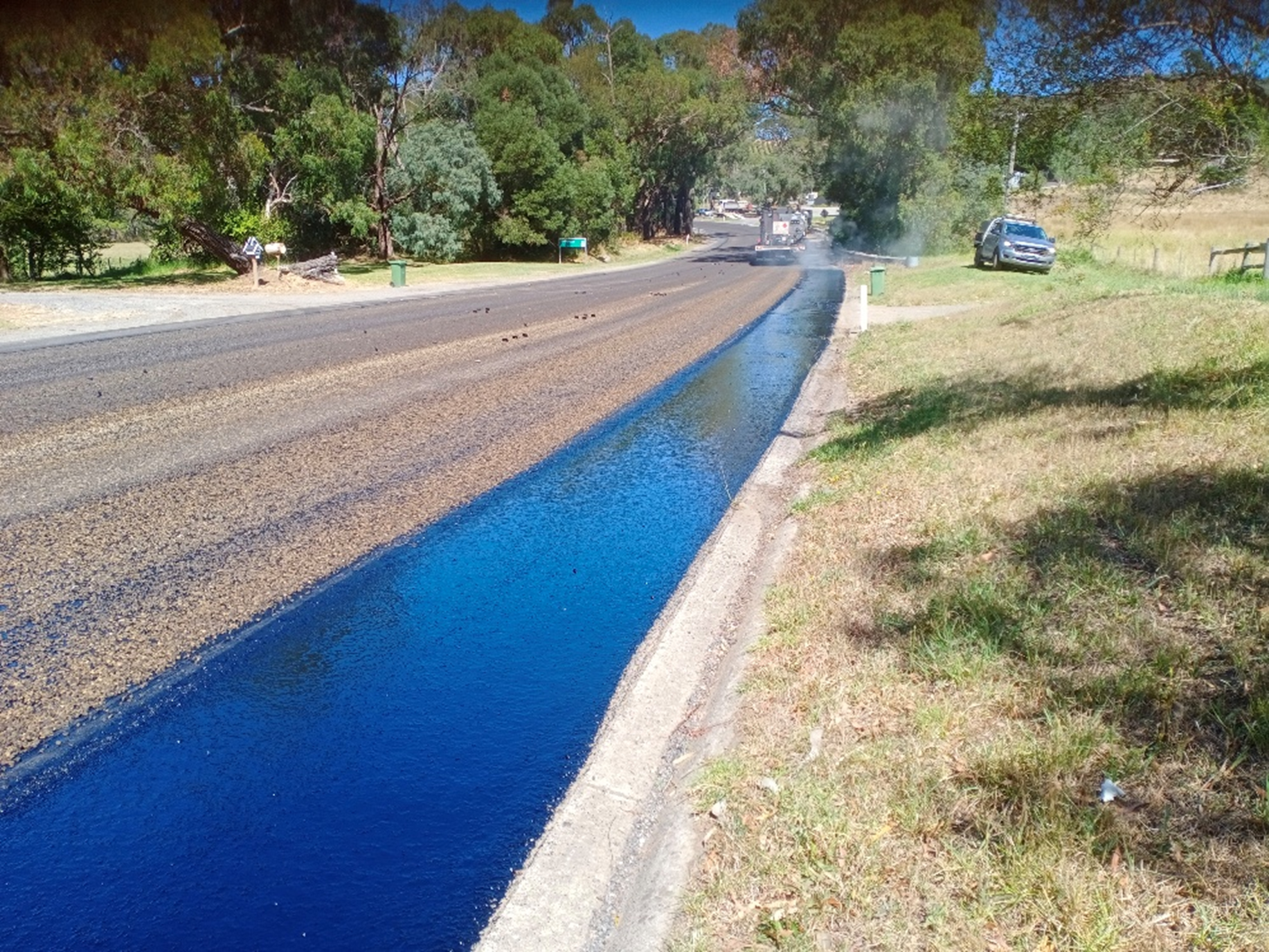
Hot Spray Seal Applications and What It Looks Like
A sprayed seal is a thin road wearing course that carries vehicle traffic. In its simplest form, a seal is a single layer of a bituminous binder on a substrate and covered in Australia with a single layer of aggregate being crushed rock. The application rate of bituminous binder can range between 0.7 to 2.8 L/m2 thick. This means it is a very thin layer of binder covered by aggregate which is crushed rock of nominal sizes of between 5 and 20 mm.
Bituminous binder or bitumen is a product with a strong odour predominantly derived from crude oil refining. Details on the types of seal treatments and binders used in Australia are available from the following documents available at www.austroads.gov.au.
A seal has several applications including those as follows.
- As an initial treatment on a prepared substrate such as a crushed gravel granular base course, timber bridge deck, or concrete;
- As a final treatment on an initial seal treatment, over asphaltic concrete, over microsurfacing or slurry seal, or even as an initial treatment (see later about expected lifetimes);
- As a retreatment (resurfacing) over an existing final seal.
But there are many combinations of binder and aggregate depending on traffic volume, waterproofing requirements, heavy vehicles (type of traffic), environs, availability of materials and quality of application. Refer to Austroads Part 4K listed above.
Lifetime of a Hot Sprayed Seal
An initial seal treatment is intended to have a lifetime of a matter of months, of 1 to 3 years or up to 10 years but this is really a final seal treatment. Final seals are intended to be of a longer term between 8 to 25 years in age depending on traffic volume/type/mix, quality of binders and the environment.
Final Seals
Scenario 1
A final seal has to be fit for purpose (FFP). In regional Australia a sealed road may not carry much traffic, e.g. less than 100 vehicles per day with a small proportion of heavy vehicles. Local governments responsible for such roads may be using a Class 170 or 240 bitumen (similar to 60-70 Pen bitumen) as the seal binder covered with a 10 mm or 14 mm aggregate. It is a straightforward and simple treatment that is FFP. It provides adequate adhesion between the bitumen and aggregate along with good durability and at low cost.
Scenario 2
But what happens when the same road network has some short but steep hills where trucks will slow down climbing the hill. Consequences could be that loaded heavy vehicles slow down and embed the stones into the Class 170 or 240 bitumen, thus reducing the surface texture. Worse, the surface texture could be reduced such that the surface in the truck wheelpaths becomes flush with excess bitumen. Now you could have a defect with low surface texture impacting skid resistance in wet weather.
In Scenario 1, the proportion of trucks was low so the impact may not be significant but it depends on the load in the trucks. Another factor that can impact seal behaviour is the spread rate of the cover aggregate. If spread too heavily this can contribute to seal flushing even without slow heavy vehicles. Guidance on aggregate spreading is available in the following document available at www.mainroads.wa.gov.au (Engineering Road Note 14, Guide to Spreading Aggregate in a Seal,
Main Roads Western Australia September 2018).
Scenario 3
Revisiting Scenario 2 what if the proportion of heavy trucks is higher with trucks slowing down, applying more load and increasing tractive effort. Results are likely to be flushing of the seal and in hot weather seal pick up where hot truck tyres delaminate the seal from the substrate. Is the seal in Scenario 1 FFP for Scenario 3? Probably not. So, what happens now aside from a rapidly deteriorating road surface? We would have to go back in time to before the seal was applied.
Options to achieve improved performance include using a more robust binder such as a polymer modified binder (PMB) or increasing the size of the aggregate to facilitate embedment of the aggregate into the seal binder. However, the PMB has a higher consistency than the Class 170 or 240 bitumen and there will be less embedment of a 14 mm aggregate. Regardless, if it is going to a larger aggregate, then it is strongly recommended that the seal type is upgraded to a double/double seal.
A double/double seal is an application of the binder, application of a larger sized aggregate, rolling and then application of a second coat of binder which is covered with a smaller sized aggregate nominally half the size of that used in the first coat. Austroads Part 4K shows the makeup of such a treatment.
So, let's choose a 14/7 mm double/double seal treatment applied with an S15R crumb rubber binder. It is a more robust treatment that is FFP for this scenario. However, it will cost more! True but if we stay with the Scenario 1 treatment a lot of maintenance will be required along with user feedback. The higher cost equates with improved seal performance.
Scenario 4
Same road and the same hill but we did not consider that this area has very hot summers with road temperatures of the order of 75 ºC plus over a long period of time. Then a mine opens with a lot of triple or quad road trains so gross mass more than 150 tonnes. Would the treatment at Scenario 3 be FFP? Maybe but really pushing the boundaries in terms of performance.
Let's say the seal applied for Scenario 3 became flush and picked up in places, is that performance adequate or should a more robust treatment be applied to cope with the road geometry with slow trucks, vehicle sizes and very high road temperatures. The flush seal will be a continuing maintenance problem and in wet weather skid resistance could be a problem.
Scenario 4A
Let's have another go at a treatment selected for Scenario 3 to enhance its performance to cope with Scenario 4. The S15R crumb rubber binder selected in Scenario 3 is a more robust binder than where we started in Scenario 1 with straight bitumen, but the flashpoint of S15R is about 64 ºC so only 16 ºC more than bitumen. What if we could use a binder that has a softening point much higher, either 70-80 ºC or above 100 ºC depending upon the dosage of the special polymer in your normal bituminous binder.
Sripath Technologies LLC has an additive called PGXpand® used for asphalt paving applications providing rutting/ fatigue resistance and lowering binder viscosity at higher temperatures, improving the workability of the mixture.
In Australia, the potential to use PGXpand® to improve sprayed sealing applications has already been explored by many contractors and road authorities. A low dose, less than 1% by binder weight, of PGXpand® can modify various binders to achieve improved seal performance through the binder having enhanced properties including:
- High softening points so the binder does not soften in extreme summer weather; and
- Higher consistency than other modified binders; plus
- Reduction in viscosity at typical spraying temperatures, thus improving binder/aggregate adhesion, reducing the likelihood of seal stripping assuming the aggregate is not wet or dirty with dust.
So, let's take the treatment proposed for Scenario 3 and add PGXpand® to the S15R at its point of manufacture then transport the modified binder to the site for the seal application. The modification of the S15R with PGXpand® should make the treatment FFP for Scenario 4.
PGXpand® is being used with success in Victoria for XSS treatments and details can be provided on request. It is considered that PGXpand® incorporation can provide a robust seal treatment for spray seal applications that would be considered as being ideal for a HSS1 or HSS2 (high stress seal), or an XSS (extreme stress seal) as documented in Austroads Part 4K. PGXpand® is available in Australia from Sripath Asia-Pac.
For more information about hot spray seals and PGXpand, contact info@sripathapc.com.
