
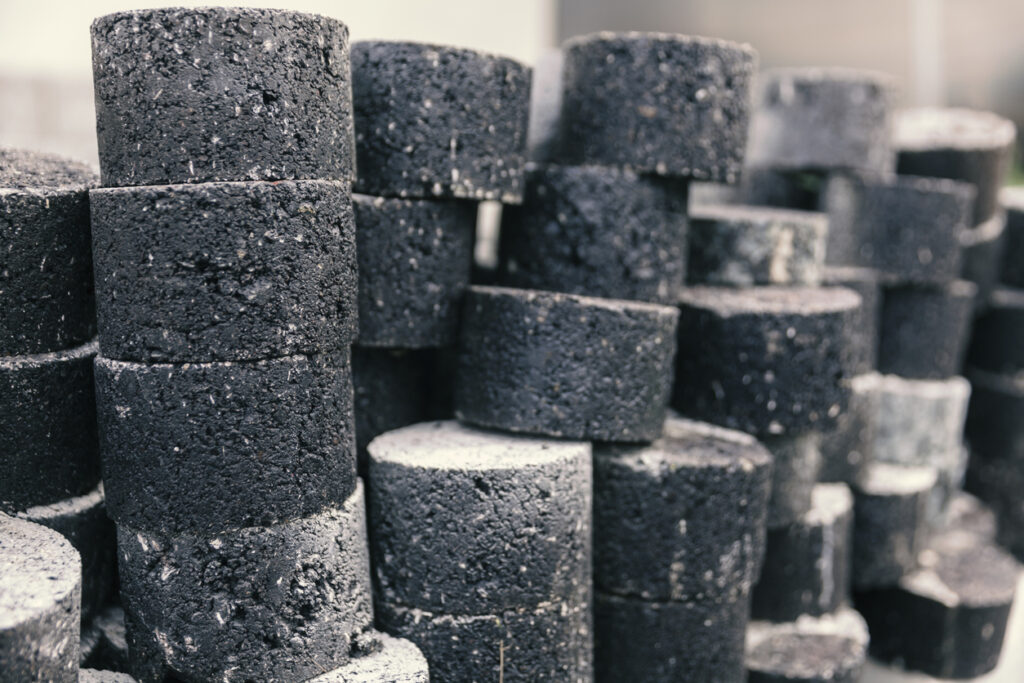
The use of reclaimed asphalt and recycled asphalt materials is becoming increasingly widespread. High-RAP mixtures, or those defined as those containing more than 25% RAP by total mix weight, can offer significant environmental and economic benefits by reducing reliance on virgin aggregates and binder.
However, increasing RAP content can introduce performance challenges. The aged binder in RAP is typically stiff and brittle, which can negatively impact cracking resistance and long-term durability. To address this, asphalt rejuvenators, also referred to as asphalt rejuvenating agents or asphalt recycling agents, are used to restore binder flexibility and rebalance performance.
The key question for producers and engineers is whether high-RAP mixes treated with an effective rejuvenator perform as well as (or better than) traditional mixes. The answer lies in performance-based testing and a balanced mix design approach.
High-RAP Mixes and Balanced Mix Design
Incorporating high levels of recycled asphalt into new mixtures requires careful consideration of material properties and performance targets. A balanced mix design framework ensures mixtures are evaluated for both rutting resistance and cracking performance rather than relying solely on volumetric properties.
While RAP can enhance rutting resistance due to its stiffness, it can also increase susceptibility to cracking if not properly treated. This is where asphalt modifiers, including rejuvenators, can play a critical role. An effective asphalt rejuvenating agent does more than soften the binder. It restores the functional properties of the aged asphalt, helping to improve flexibility without sacrificing durability.
Performance testing is essential to validate that this balance has been achieved.
Key Performance Tests for Rejuvenated Mixes
A range of established laboratory tests can be used to evaluate how high-RAP mixtures with asphalt rejuvenators will perform in real-world conditions. Several of these tests are particularly sensitive to the effects of rejuvenation.
Semi-Circular Bend (SCB) Test
The SCB test evaluates intermediate-temperature cracking resistance by measuring fracture energy and flexibility index. These parameters indicate how well a mixture can resist crack initiation and propagation under traffic loading.
For mixtures containing reclaimed asphalt, SCB testing is highly effective in demonstrating the benefits of an asphalt recycling agent. Improved fracture energy values typically indicate that the rejuvenator has successfully restored flexibility to the aged binder.
IDEAL-CT (Cracking Tolerance) Test
The IDEAL-CT test provides a practical measure of cracking resistance through the Cracking Tolerance (CT) Index. This test is widely used in balanced mix design workflows due to its simplicity and sensitivity to binder and mix component.
High-RAP mixes without proper treatment often exhibit low CT Index values. In particular, ineffective asphalt rejuvenators or improper dosing of rejuvenators in high-RAP mixes can often reveal poor performance in aged binder or mix testing results. However, mixtures treated with an ideal asphalt rejuvenator can achieve cracking resistance comparable to that of virgin mixes and also demonstrate similar aged mix or binder results.
Disk-Shaped Compact Tension (DCT) Test
The DCT test focuses on low-temperature cracking performance and measures fracture energy under conditions that simulate thermal contraction.
Because recycled asphalt binder is more prone to thermal cracking, this test is particularly important for validating the effectiveness of an asphalt rejuvenating agent. Strong performance in DCT testing indicates improved durability in colder climates, particularly at high rates of loading.
Texas Overlay Test
The Texas Overlay Test evaluates a mixture's resistance to reflective cracking under cyclic loading. It measures the number of cycles to failure as a specimen is repeatedly opened and closed, simulating movement from underlying pavement cracks.
For mixtures containing reclaimed asphalt, this test is especially useful in assessing the effectiveness of an asphalt rejuvenator. Higher cycles to failure indicate improved flexibility and strain tolerance. When a well-formulated asphalt recycling agent is used, high-RAP mixes typically show significant gains in cracking resistance, confirming the mixture can better withstand real-world pavement stresses.
4-Point Beam Bending Fatigue
The 4-Point Beam Bending Fatigue test evaluates a mixture's ability to resist cracking under repeated traffic loading. It measures the number of load cycles to failure under controlled strain, providing insight into long-term fatigue performance.
For high-RAP mixtures, fatigue resistance is a key concern due to the stiffness of recycled asphalt binder. Incorporating an effective asphalt rejuvenating agent helps restore viscoelastic properties, allowing the mixture to better dissipate strain. This is reflected in increased fatigue life, demonstrating that properly designed mixes using asphalt modifiers can achieve durable, long-lasting performance.
Bending Beam Rheometer (BBR) Considerations
The BBR test evaluates binder-level properties such as creep stiffness and relaxation at low temperatures. While not a mixture test, it provides valuable insight into how an asphalt recycling agent is interacting with aged binder.
Testing extracted and recovered binder from high-RAP mixtures can help confirm whether the rejuvenator is restoring low-temperature performance. However, binder results should always be considered alongside mixture-level testing for a complete evaluation.
Hamburg Wheel Tracking Test
The Hamburg Wheel Tracking Test evaluates a mixture's resistance to rutting and moisture damage under repeated loading in a water bath. It measures rut depth and identifies stripping potential, providing insight into both structural stability and durability.
For mixtures containing reclaimed asphalt, this test helps confirm the addition of an asphalt rejuvenator does not compromise rutting resistance. Low rut depths and minimal stripping indicate the asphalt recycling agent has maintained binder cohesion and aggregate adhesion. Strong performance in Hamburg testing demonstrates high-RAP mixes can achieve durability and moisture resistance comparable to conventional designs.
Asphalt Pavement Analyzer (APA) Rut Test
The APA test evaluates rutting susceptibility by applying repeated loading to a compacted specimen at elevated temperatures. It measures permanent deformation, offering a controlled assessment of a mixture's resistance to rut formation.
For high-RAP mixtures, the stiffness of recycled asphalt can contribute to improved rutting performance, but the role of asphalt modifiers remains critical. An effective asphalt rejuvenating agent ensures flexibility is restored without sacrificing structural integrity. Low rut depths in APA testing confirm the mixture maintains a balanced performance profile, supporting balanced mix design.
Which Tests Are Most Relevant to Asphalt Rejuvenation?
Not all tests respond equally to the presence of asphalt modifiers like rejuvenators. IDEAL-CT and SCB are generally the most sensitive to changes in intermediate-temperature cracking resistance, making them key tools in evaluating reclaimed asphalt mixtures.
DCT testing provides critical insight into low-temperature behavior, while BBR offers supporting data at the binder level. Together, these tests form a comprehensive framework for assessing whether a balanced mix design has been achieved.
Interpreting Conflicting Test Results
It is not uncommon for different performance tests to yield varying results. For example, a mix may perform well in SCB testing but show more modest improvements in IDEAL-CT or exhibit strong binder properties in BBR without equivalent gains at the mixture level.
These differences reflect the complexity of recycled asphalt systems. Each test captures a different aspect of performance, from crack initiation to propagation and thermal response. When evaluating high-RAP mixes with asphalt rejuvenators, it is important to look at the overall performance trend rather than relying on a single metric.
A true balanced mix design prioritizes consistency across multiple tests, ensuring that improvements in one area do not come at the expense of another.
Connecting Lab Results to Real-World Performance
Performance tests are designed to simulate real-world pavement conditions. For example, SCB closely relates to fatigue cracking under traffic, IDEAL-CT relates to crack initiation and propagation, and DCT and BBR address thermal cracking risks.
When a high-RAP mix incorporating an effective asphalt rejuvenating agent performs well across these tests, it provides strong evidence that the material will deliver long-term durability in the field. In many cases, properly designed mixtures using reclaimed asphalt can match or exceed the performance of conventional mixes.
The Role of ReLIXER Asphalt Rejuvenator in High-RAP Mixes
Advanced asphalt rejuvenators like ReLIXER® restore the functional properties of aged binder in RAP, enabling higher usage of reclaimed asphalt without compromising performance. High-quality rejuvenators can deliver balanced performance as shown across a variety of trials and tests aligning with balanced mix design principles established by various municipalities or agencies.
Intermediate-Temperature Cracking Improvements
Field and lab data demonstrate clear benefits of ReLIXER for intermediate-temperature cracking.
- IDEAL-CT Testing: A 50% RAP mixture's CT Index increased from ~43 (control) to 63 with ReLIXER, indicating improved crack initiation and propagation resistance.
Low-Temperature Performance Enhancements
ReLIXER also improves properties of mixtures at low temperatures, where recycled asphalt is most vulnerable. The following tests using ReLIXER show that the rejuvenated binder can resist thermal contraction and cracking stress.
- DCT Testing: Fracture energy exceeded 450 J/m² benchmark in tests undertaken for the Illinois Tollway, where higher ReLIXER dosages also resulted in monotonically increased DCT values.
- BBR Testing: Reduced stiffness and improved relaxation characteristics in recovered binder.
Maintaining Rutting Resistance
Balanced mix design requires cracking improvements without sacrificing rutting resistance.
- Hamburg Wheel Tracking: Results showed rut depths remained below required specification limits, confirming ReLIXER does not compromise structural integrity.
- Flow Number Tests: Flow and stability values remained consistent with durable mix behavior.
Binder-Level Validation
Recovered binder analysis supports mixture-level results:
- Reduced stiffness (BBR) and improved relaxation (ΔTc).
- Maintained PG grading (e.g., PG 64-22), showing rejuvenation restores balance rather than over-softening.
Field Performance Across Projects
Real-world applications reinforce lab findings:
- Projects in the U.S., India, and Australia: 40-50% RAP mixes showed excellent workability, durability, and cracking resistance.
- Example: ~2,000 tons of 40% RAP placed in a U.S. state trial with improved low-temperature properties and fatigue resistance.
- Air-oxidized binder systems treated with ReLIXER: CT Index improvements from ~182 to 242.
Consistent Performance Across Tests
ReLIXER's benefits are evident across SCB, IDEAL-CT, DCT, and binder-level evaluations, providing comprehensive validation:
- Enables higher RAP content confidently.
- Positions high-RAP mixes as both sustainable and technically superior when paired with the right rejuvenator.
Optimizing Asphalt Rejuvenators for High-Performance Recycled Asphalt
The use of reclaimed asphalt and recycled asphalt is essential for building more sustainable infrastructure, but performance must remain the top priority. With the right asphalt rejuvenator and a comprehensive testing strategy, high-RAP mixtures can achieve a balanced and durable performance profile.
Established tests such as SCB, IDEAL-CT, DCT, and BBR provide the tools needed to evaluate these materials with confidence. When combined with a balanced mix design approach, they demonstrate that rejuvenated asphalt mixtures are a high-performance solution.
For more information about asphalt recycling, asphalt rejuvenators, and ReLIXER, contact info@sripath.com.
